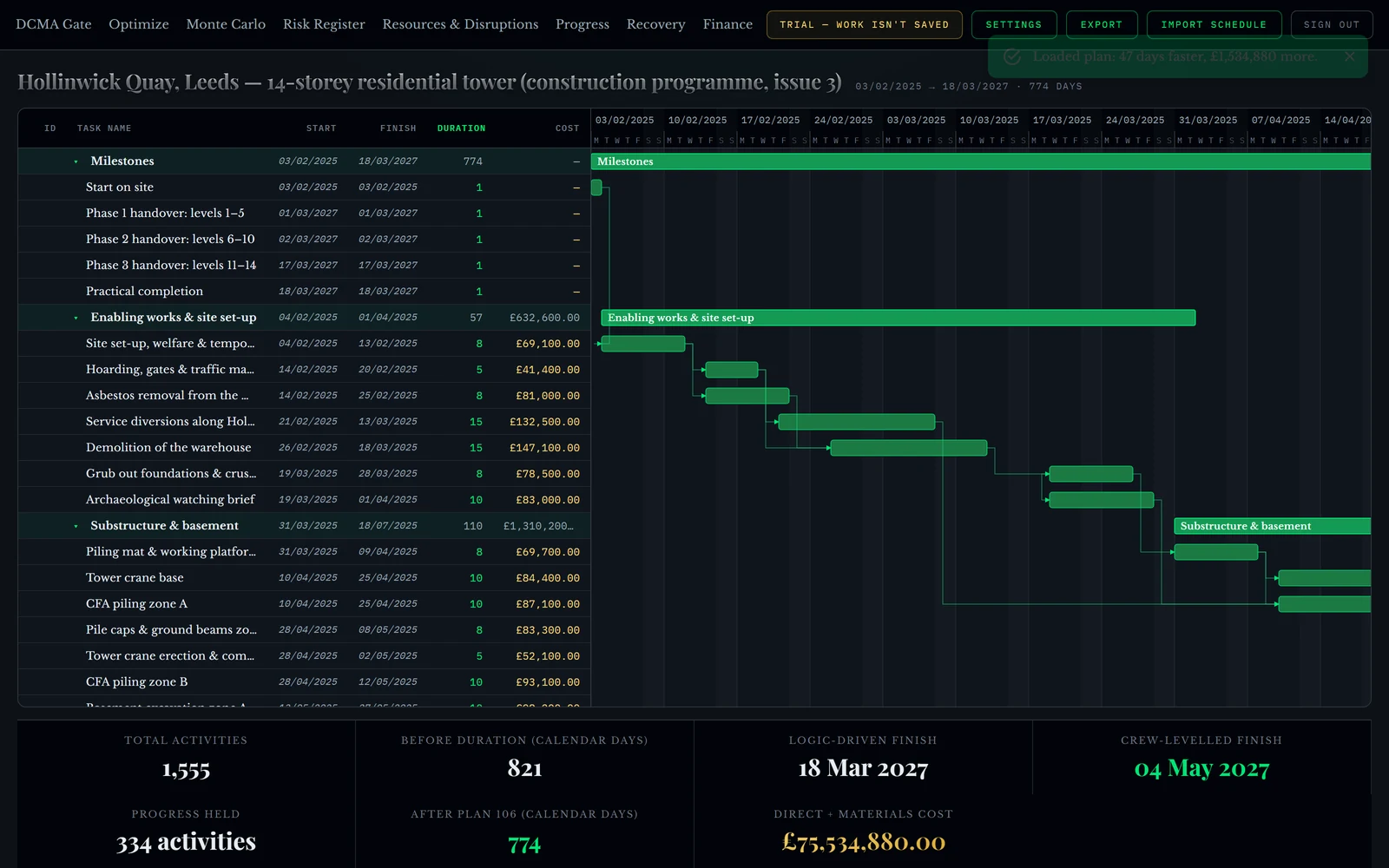
Month 14 on a fourteen-storey tower in Leeds. The frame gang lost ten working days on each of four floors over the winter, and the programme everyone is now working to finishes on 4 May 2027 instead of 18 March: thirty working days, six working weeks. The client wants the date back. The QS wants to know what that costs. The site manager wants a plan the gangs can live with. The project manager wants the fewest reissued dates, inside the window already promised to the subcontractors. Four honest asks; the recovery meeting usually answers one. So I built the tower, slipped it, and asked for all four.
The programme
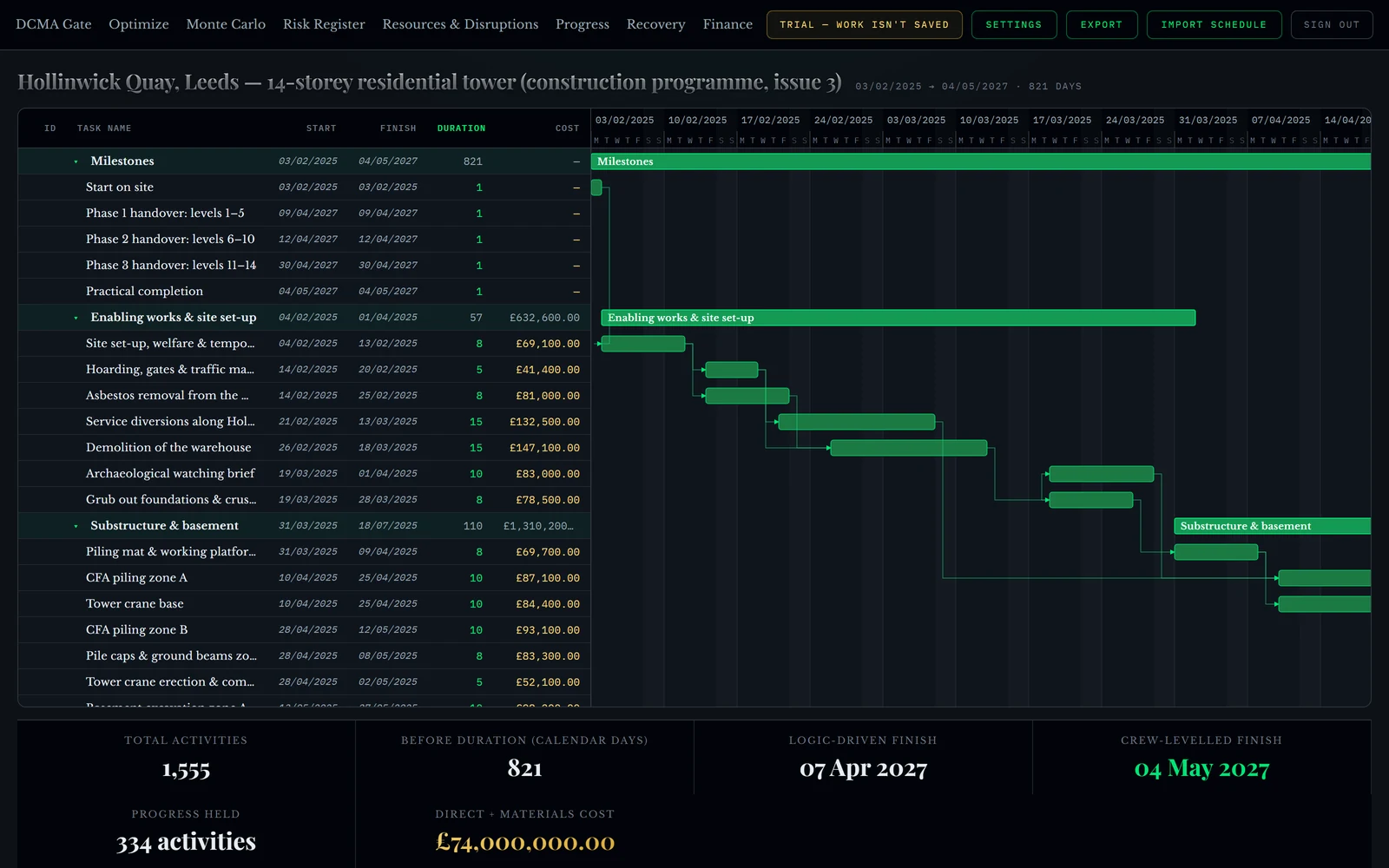
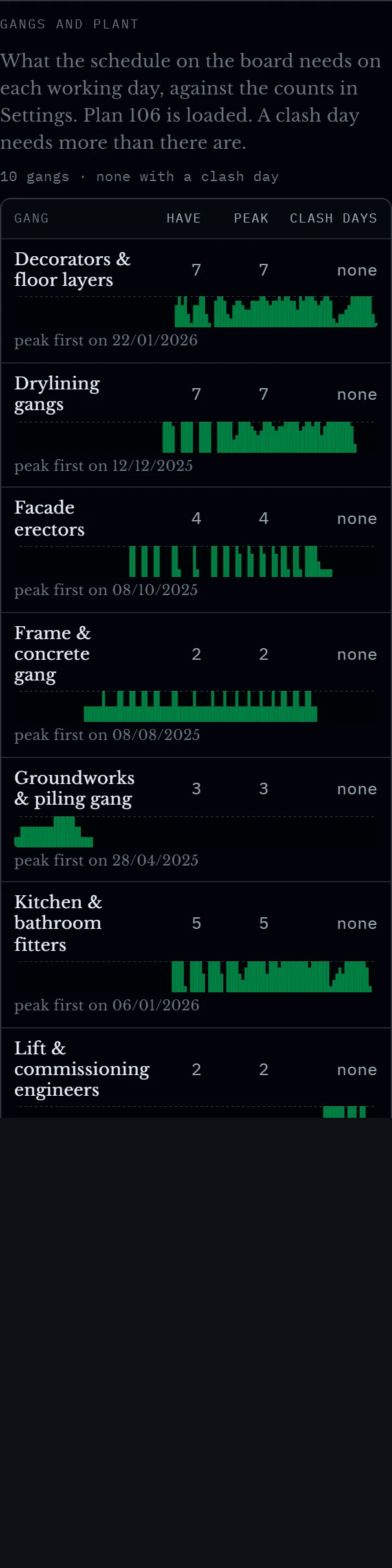
Hollinwick Quay is a generated scheme: a 14-storey tower over a two-storey podium, 182 flats, £74,000,000 of priced work, 1,555 activities and 2,180 links from 3 February 2025. Ten trades on hourly rates with the gang counts the file declares: nine M&E fitters, seven drylining gangs, five kitchen and bathroom fitters, seven decorators and floor layers, three snagging teams, two frame gangs. Standing costs of £55,000 a week for site management, welfare, security and hoists, added through the app. The developer and the scheme are invented; the shape of the job is not.
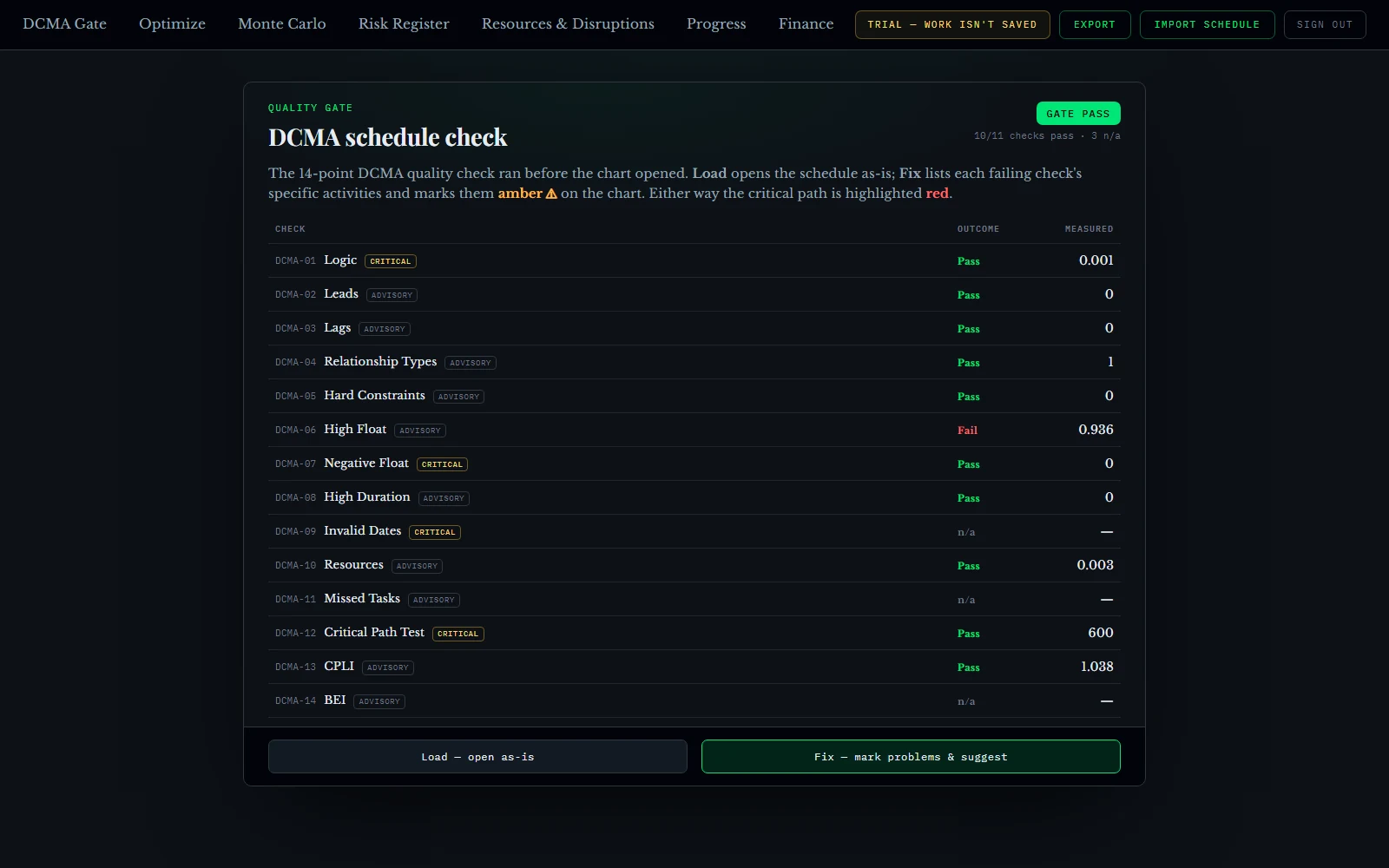
The file went in through the welcome page with the option that invents a faster way of working for every activity. I set it to 60% of the duration for 120% of the cost; the app's defaults are 70 and 180, and both are a judgement. Import took seven seconds. The fourteen-point check passed ten of eleven: high float fails, as it should, because read by logic alone 94% of this job could float more than 44 days. Gangs pace a tower, not links. With the dates limited by the gang counts, the board's finish moved from 22 February to 22 March 2027.
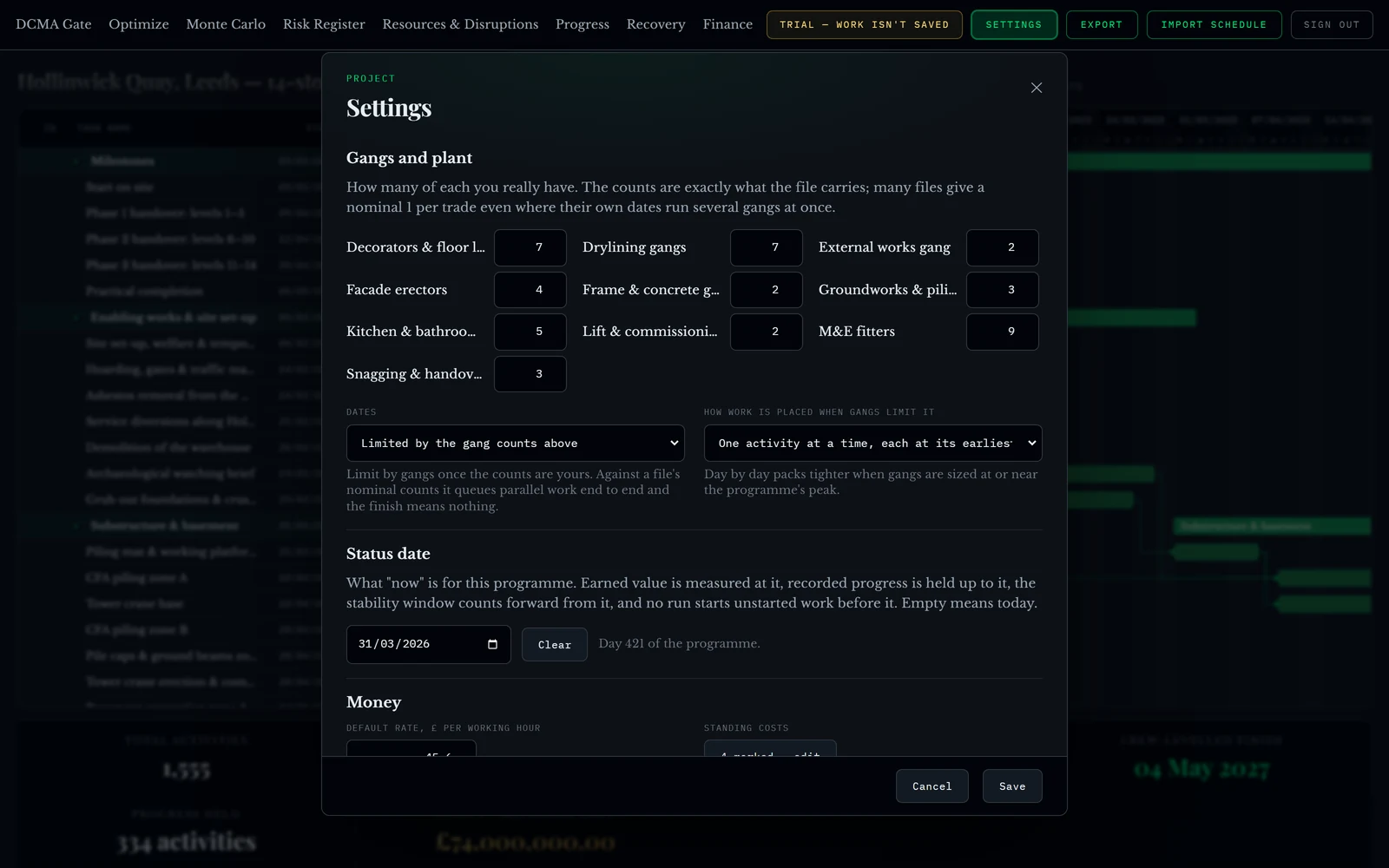
A first search on the issued file gave the plan nearest the issued dates: the file's own way of working throughout and a finish of 18 March 2027. That became the baseline, the programme the subcontractors were sent.
Fourteen months later
Floors four to seven of the frame took 28 working days each instead of 18, and everything above and behind them waited. The progress went in through the app's own progress service, not the database: 334 observations at a status date of 31 March 2026, 316 complete, 18 in progress, 1,221 not started. The board's Progress panel reads 24% of the work done against 25% planned by now, and forecasts 7 May 2027 against the plan's 4 May. The board stretches the started floor to its observed pace; the searches price the rest at the plan's rate, so the two differ by three days. The figures below are the searches'.
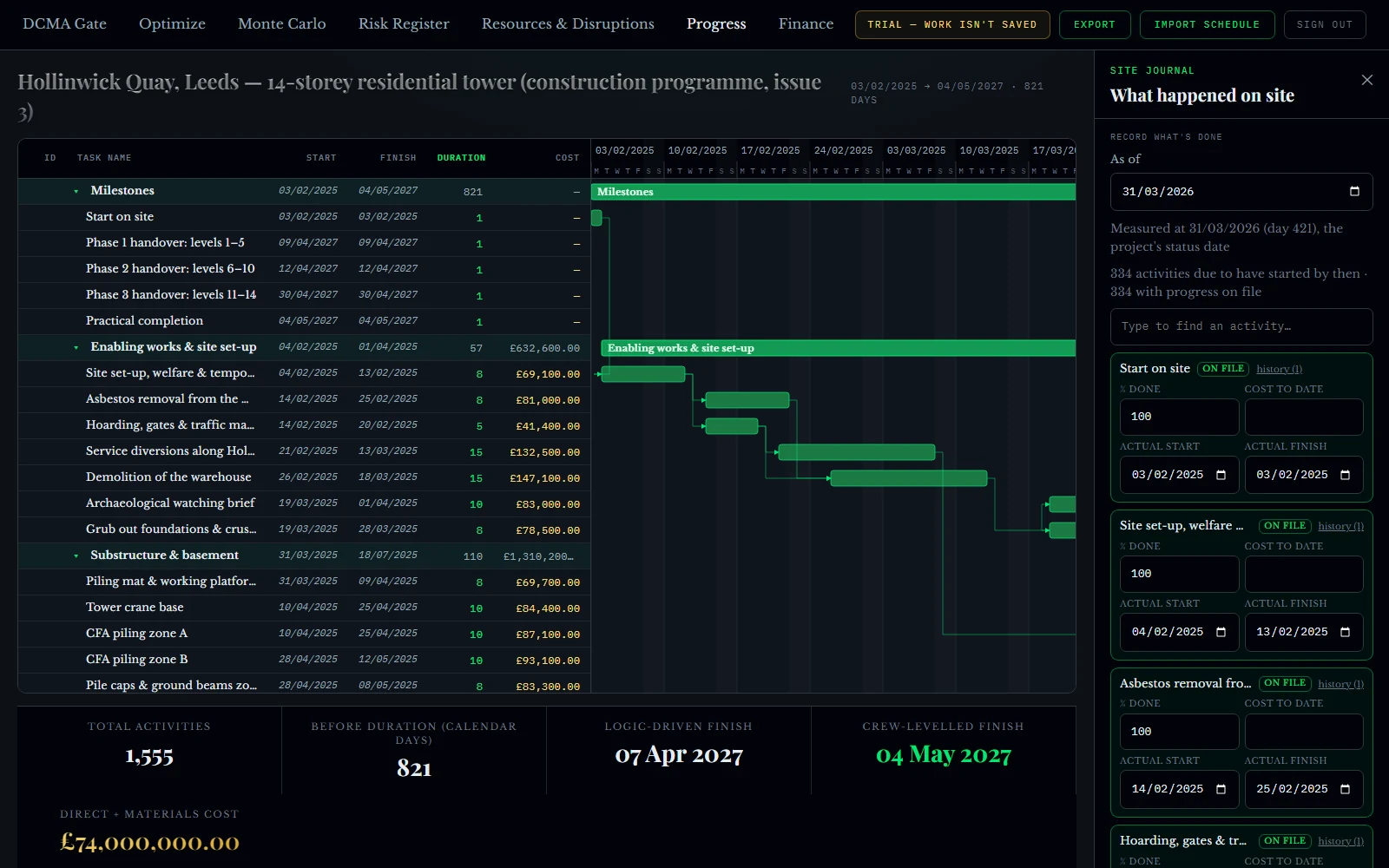
One rule sits under every search that follows. Done work stays where it was done, for as long as it took, the way it was done. Started work stays started, and only what is left of it can move. Nothing unstarted may start before the status date. The app pins all 334 before a search begins, and every plan it lists is laid out with them held.
Four people, two guards
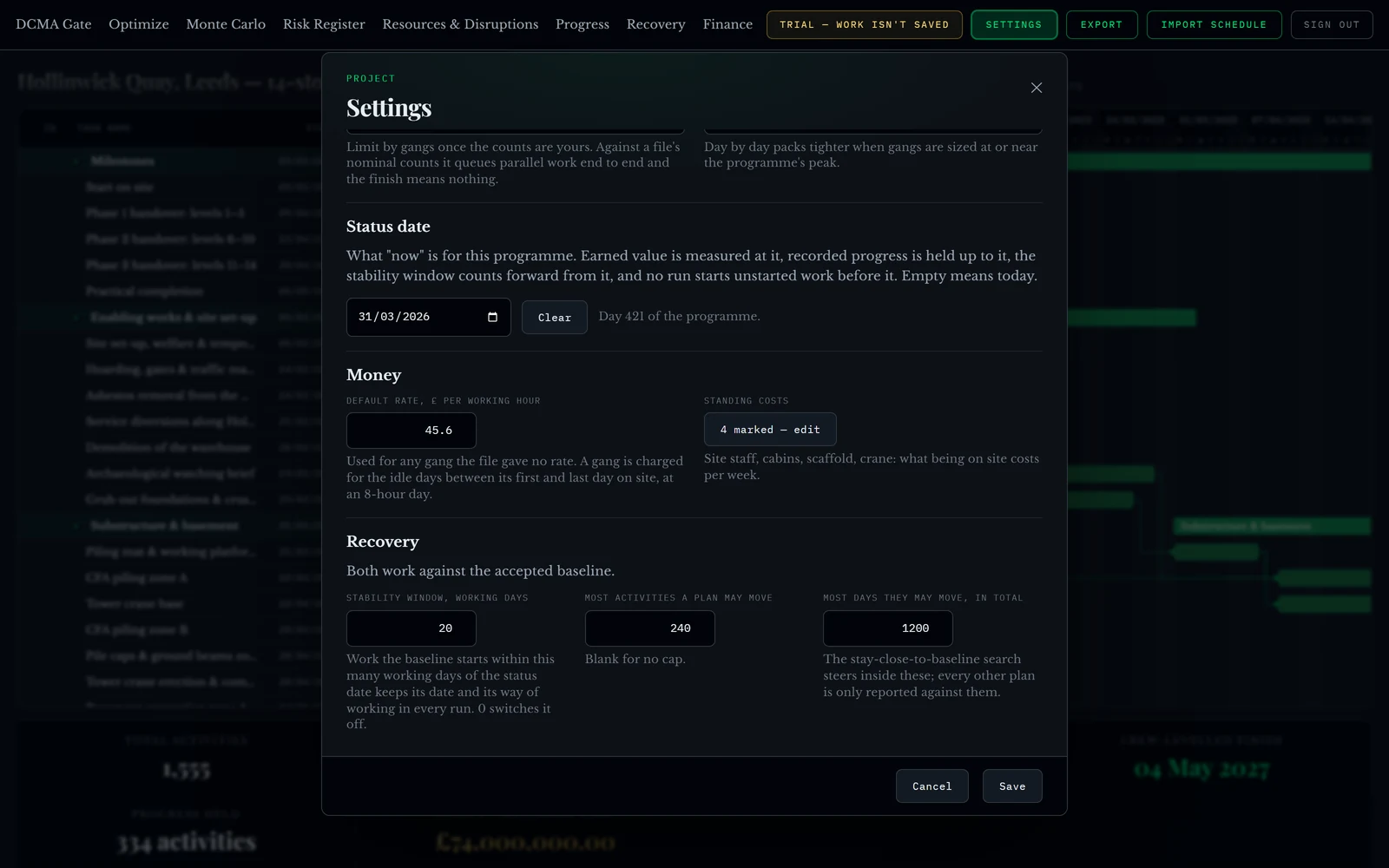
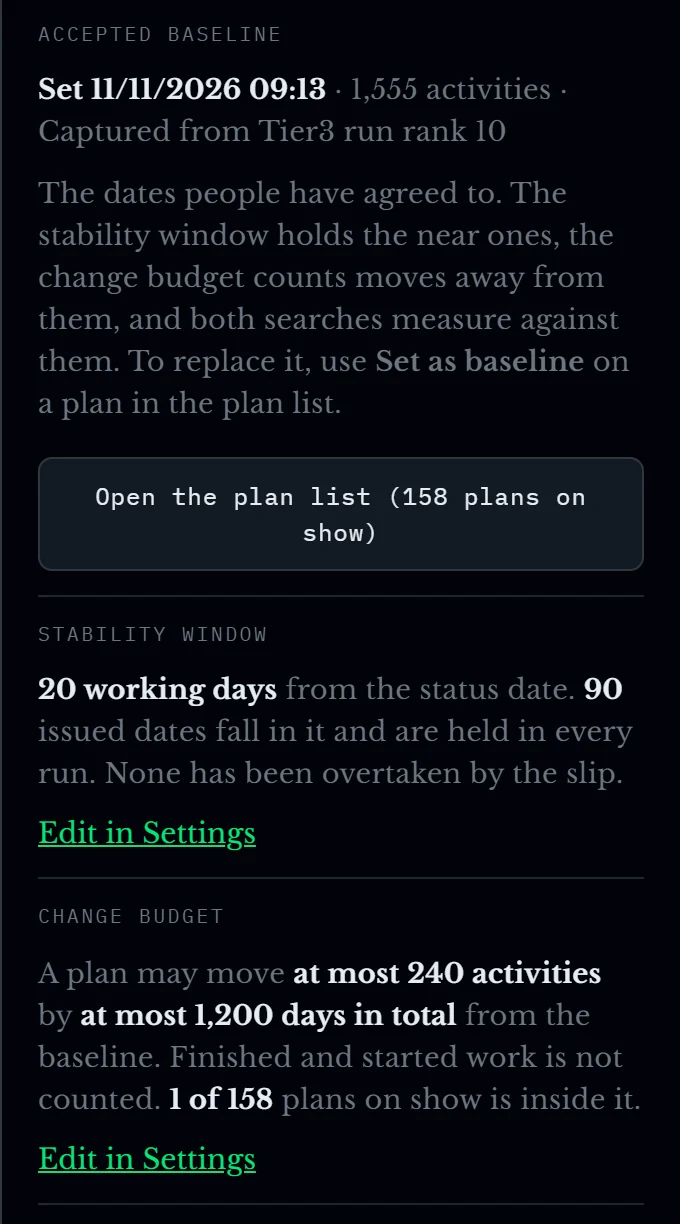
The client's goal is the date. The QS's is the all-in cost: direct work, standing costs, and the price of gangs kept on between their jobs. The late programme is £74,000,000 of direct work and £81,025,040 all in. The site manager's is a steady gang profile, which the board counts as gang changes: every gang put on or stood down, day to day, across the job. Lower is steadier, and the late programme has 1,540. The project manager's is distance from the baseline, counted in activities moved and days moved, with two guards: a stability window of 20 working days from the status date in which no issued date may move, and a change budget of 240 moved activities and 1,200 moved days, about a fifth of what is left. A fifth goal, schedule risk, rides along on the wider search; it gets this one line.
Measured against what?
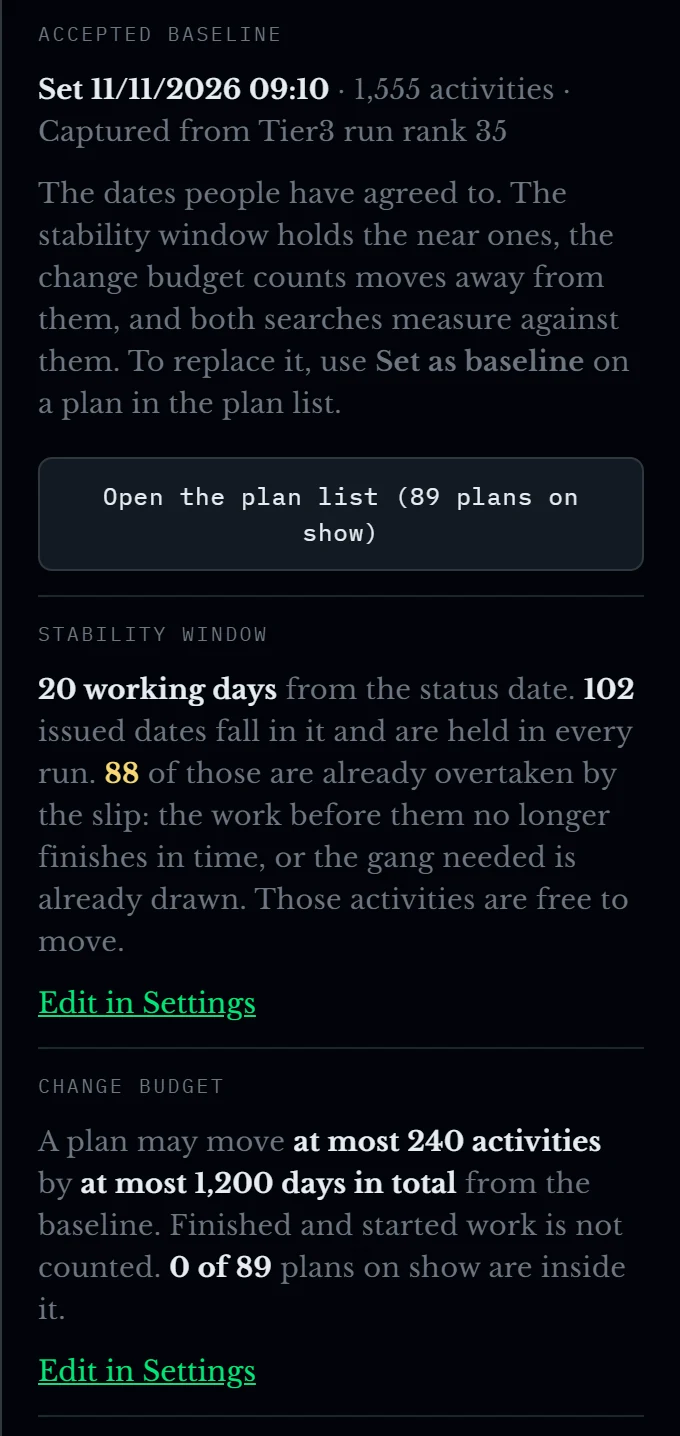
Measured against the dates issued before the slip, the guards do not mean much. The window holds 102 issued dates, and 88 of them are already overtaken: the work in front of them no longer finishes in time, or the gang they need is already drawn. A search against those dates returned 89 plans and none inside the budget. Even the plan that finishes on the same 4 May moves 1,193 activities by 56,921 days, because the slip has already moved almost everything off its issued day. Against last year's dates the project manager's goal and the client's are the same goal: back to the issued programme.
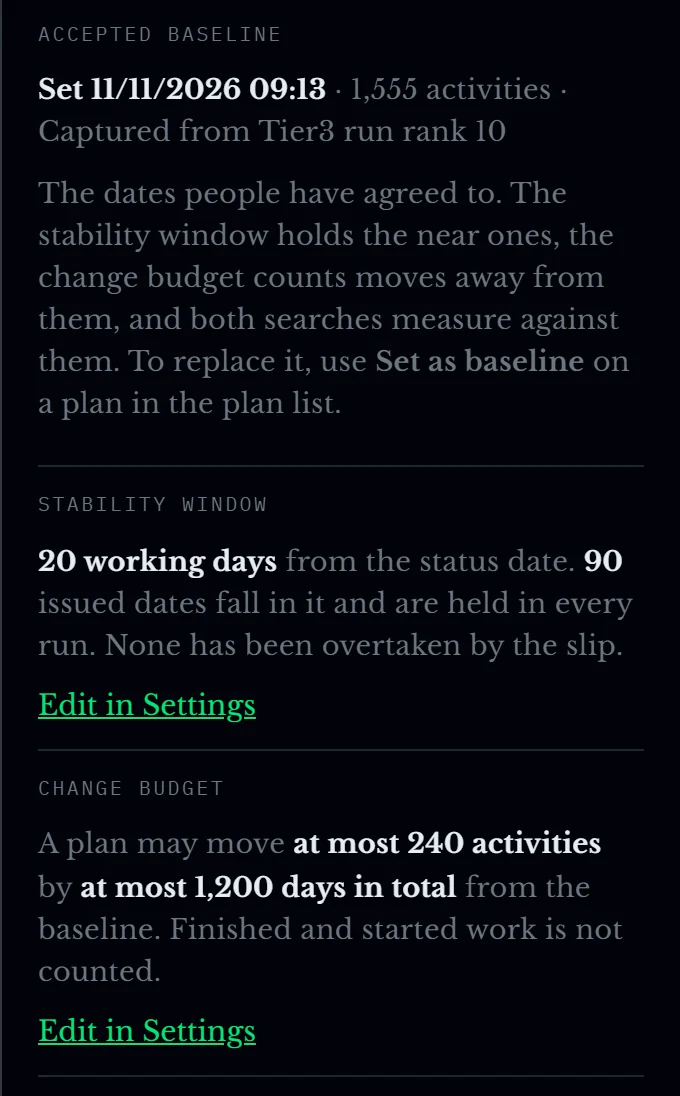
So the plan of record was switched. The late programme, as the app's own scheduler lays it out with the done work held, became the baseline, with the same window and budget against it. Now 90 issued dates sit in the window, none overtaken, and doing nothing moves nothing. That is the argument the four people are actually having: not distance from last year's dates, but change against the programme everyone is working to today.
Two searches, five minutes each
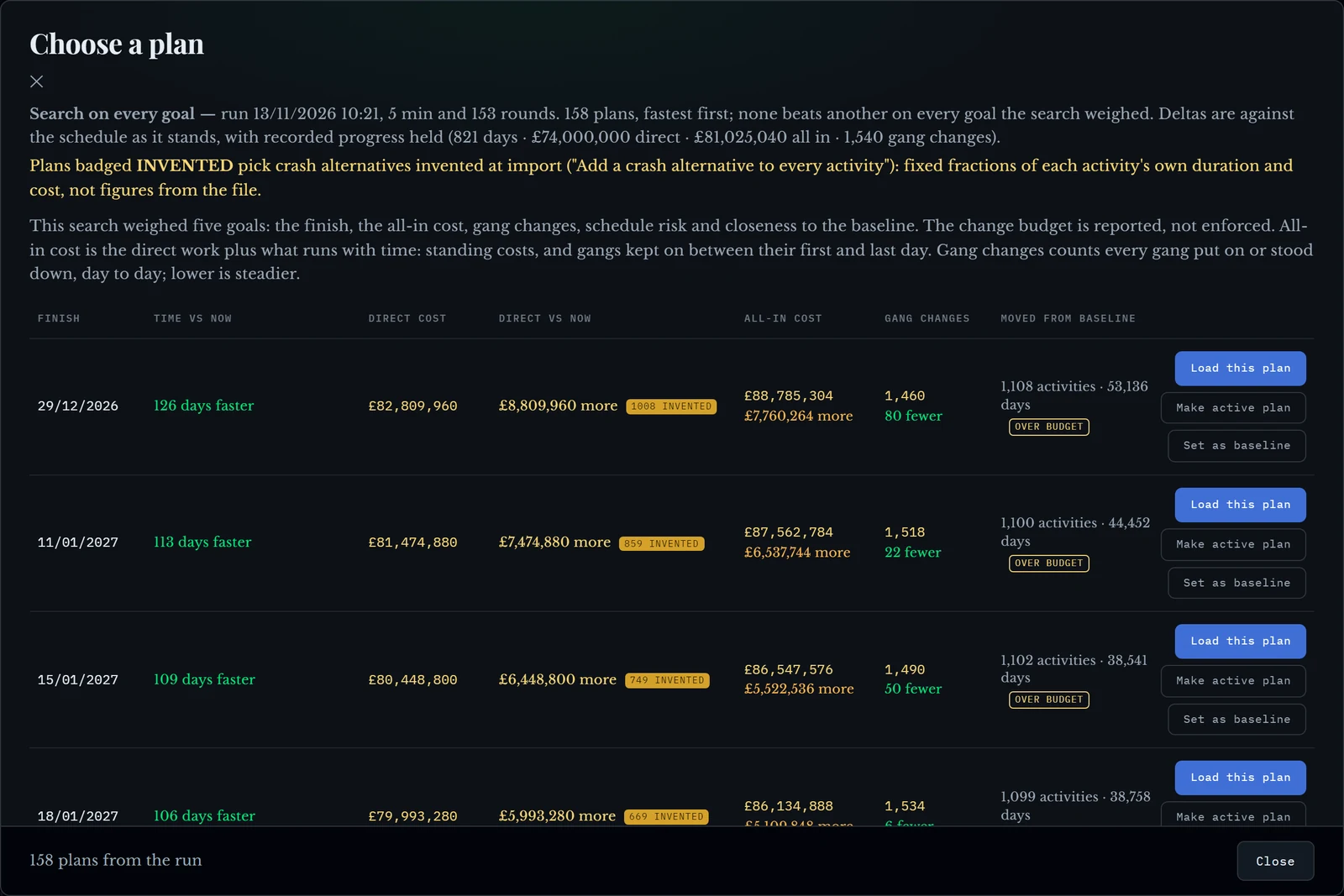
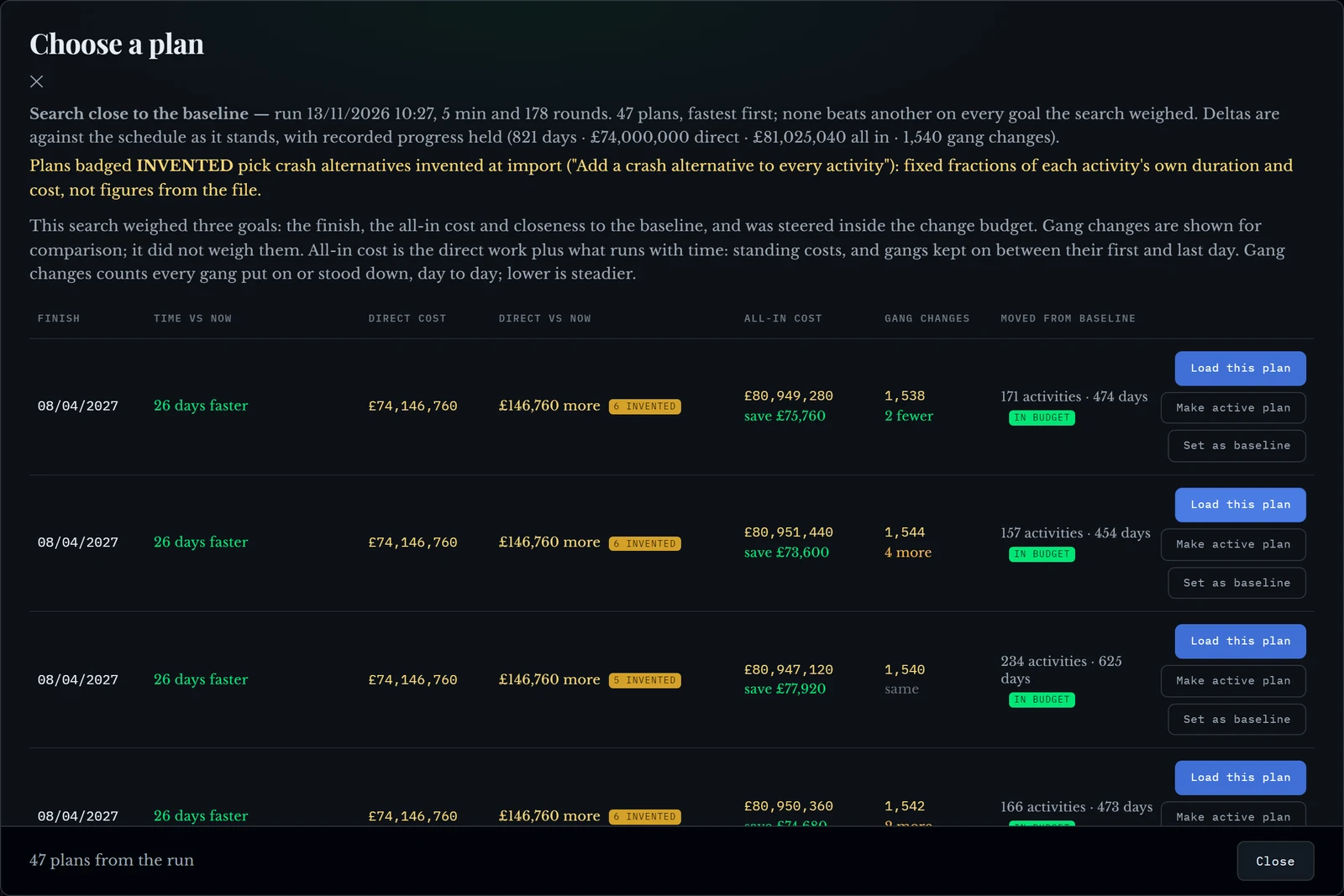
The board's Recovery panel runs two searches over everything not yet finished, on the same time box so their plans can be compared. I gave each five minutes. The first weighs all five goals and reports the budget without obeying it: 158 plans in 153 rounds, from 29 December 2026 to doing nothing, and only doing nothing is inside the budget. Every plan that recovers time moves between 774 and 1,108 open activities, because pulling time back re-orders the flats among the gangs. The second weighs date, cost and closeness to the baseline and is steered by the budget: 47 plans, all 47 inside it, in 178 rounds, nothing earlier than 8 April 2027. Steered to small changes, it cannot reach the old date. The wider search can, and says what that costs.
The menu
Back is working days recovered against 4 May 2027; the slip is 30. Cost is all in, with its change against the late programme's £81,025,040. Moved is open activities on a different day, and the days they moved by. The first three plans are from the search close to the baseline, the last two from the search on every goal.
| Plan | Finish | Back | All-in cost | Moved | Faster modes | Gang changes |
|---|---|---|---|---|---|---|
| Doing nothing | 4 May 2027 | 0 | £81,025,040 | 0 / 0 | 0 | 1,540 |
| The fewest dates moved | 23 Apr 2027 | 6 | £80,965,596 (−£59,444) | 36 / 112 | 3 | 1,538 |
| The cheapest | 15 Apr 2027 | 12 | £80,923,588 (−£101,452) | 156 / 561 | 4 | 1,550 |
| The one most could sign | 8 Apr 2027 | 17 | £80,949,280 (−£75,760) | 171 / 474 | 6 | 1,538 |
| The steadiest gangs | 23 Apr 2027 | 6 | £81,014,696 (−£10,344) | 1,010 / 15,672 | 9 | 1,438 |
| All six weeks | 18 Mar 2027 | 30 | £82,152,248 (+£1,127,208) | 970 / 8,943 | 169 | 1,572 |





The price of time
The first weeks back cost nothing. Every one of the 47 plans close to the baseline is cheaper all in than doing nothing, by £49,300 to £101,452, and so are 27 of the wider search's 158: fewer weeks of standing cost pay for the few faster ways of working they use. Beyond 8 April only the wider search has plans, and the price climbs: 20 working days back for £301,544 more, 22 for £720,096, 29 for £1,118,832, and the full 30 to the original 18 March for £1,127,208. It is not a perfectly smooth curve; the plan to 9 April costs more than the one to 5 April. Past the old date the slope is steep: 35 days back costs £1,344,724, and the fastest plan on the list, 29 December 2026, costs £7,760,264 more and leans on 1,008 invented ways of working. That is the answer to the QS, and it is an all-in answer: the direct cost of the six weeks is £1,534,880, and £407,672 of it comes back in standing costs and idle gangs.
What the site manager's goal was worth
Both searches had the same five minutes, so this is like for like. The search close to the baseline does not weigh gang changes at all, and its 47 plans sit between 1,534 and 1,556: within sixteen of doing nothing either way. The search that does weigh them found plans from 1,438 to 1,648. Its steadiest, at 23 April, has 102 fewer gang changes than doing nothing and costs £10,344 less, and it moves 1,010 activities to get there. The plan with the fewest moved dates finishes on the same 23 April with 1,538 gang changes and 36 activities moved. So the site manager's goal is worth about a hundred gang changes on this job, and the project manager pays for all of them. Where both searches reach the same date, the narrow one is cheaper: to 9 April it saves £93,020 and moves 196 activities, where the wider search's cheapest plan to that date costs £385,108 more, moves 849 and has 1,642 gang changes. The wider search earns its place at the ends: the steadier plans in late April, and every date before 8 April.
What would it take?
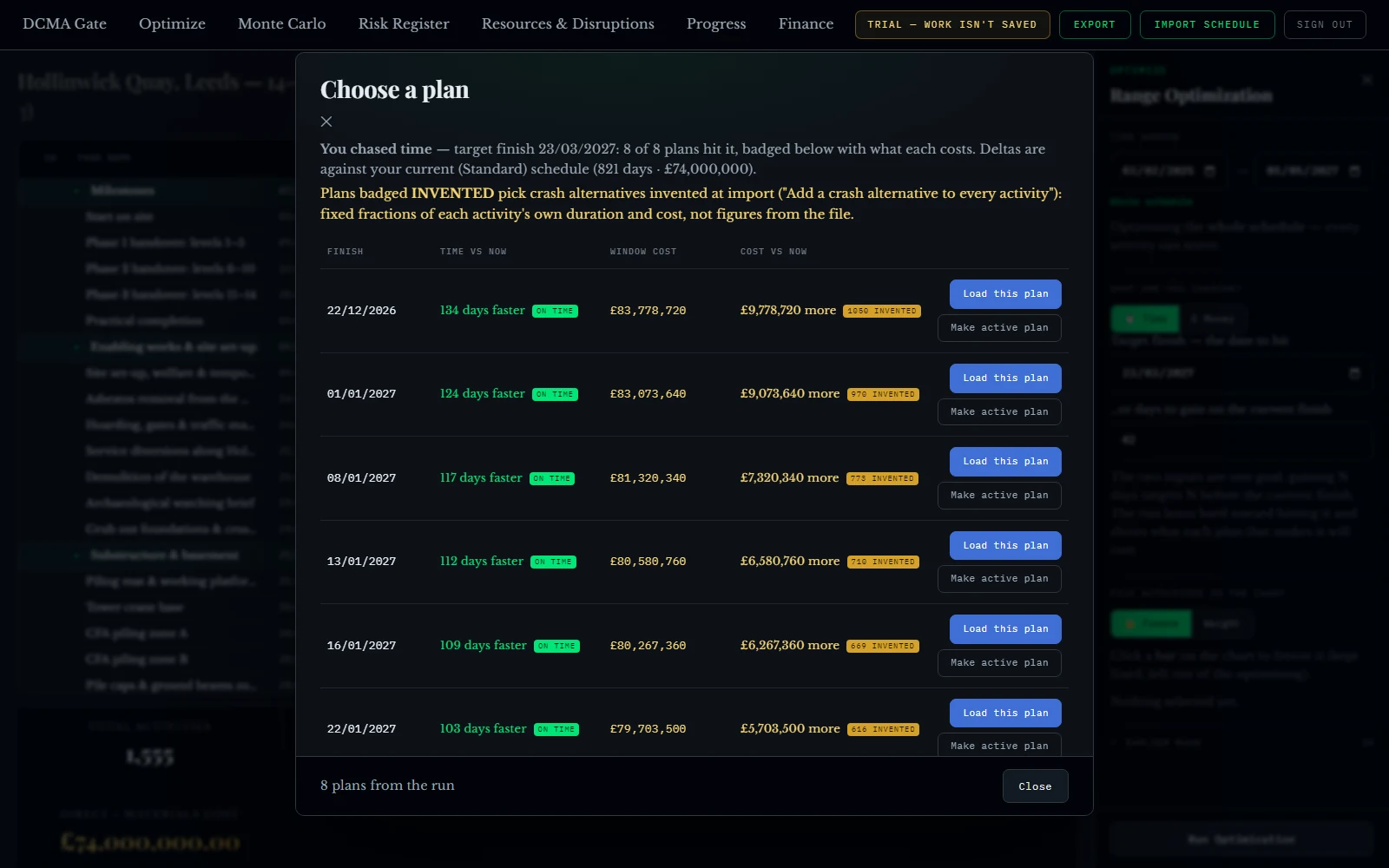
The board's "What would it take?" button only appears when the ways of working cannot reach a date, and its answer is extra crews. Here they can, so it never showed. The honest answer on this programme is the wider search's: the date is reachable, and the question is who pays the £1.13m. The thirty-second plans are dearer because that search is short and weighs direct cost alone.
Two of this article's results were fixes to the app itself: until this week the search would re-plan completed work, and the stability window would hold an issued date even when the work before it could no longer finish in time or the gang was already drawn. Both are fixed, and every figure above is from after the fix.
What this does not tell you
The faster ways of working are invented, 60% of the time for 120% of the cost, and a subcontractor can refuse any of them; the six-weeks plan leans on 169. The window and the budget are judgement calls, and the narrow search's menu moves when they do. Done work was held at the plan's rate, so the searches and the board's forecast disagree by three days. The tower crane is not modelled. Each search had five minutes; a longer one may find better, and a different run will not return the same list. Underneath the two searches is a many-goal search; the article did not need its name.
Run it on your own slip
GeneraGantt reads MS Project, Primavera P6 and Asta Powerproject. Record the progress, set the baseline everyone is actually working to, set the window you have promised and the budget you can defend, and run both searches. Take the menu to the meeting instead of one plan. Free while it is in testing, with a sample programme loaded. Nothing is saved: your schedule leaves with you.
The programme is a generated one, built so that a frame slip lands where it would on a real tower: on the floors, then on every trade behind them. Every figure is read off the app after importing the file, recording the progress through the app's own service and running the searches from the board; nothing is quoted that was not read off its screens.